
Devils Bridge – Pontarfynach, Aberystwyth
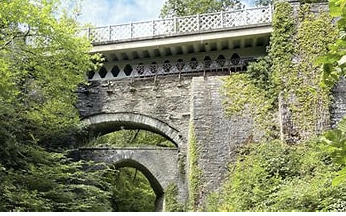
Once upon a time, in the enchanting rolling hills of South Wales, there stood a most peculiar and wondrous spot: a location where not one, not two, but three bridges perched atop each other, teetering like a stack of pancakes on Shrove Tuesday. Hard to believe, you say? Well, this is Wales, after all, where dragons roam and sheep outnumber people! The place was known far and wide as Devil’s Bridge, and its name came with a tale as strange as its architecture. It’s a remarkable piece of engineering history where the oldest bridge was preserved rather than demolished, creating this unique “stacked” structure.
Legend has it that the Devil himself, perhaps tired of his usual mischief and fancying a break from fiery brimstone, decided to build the very first bridge. But he wasn’t keen on doing the work for nothing, oh no. He struck a deal: the soul of the first living thing to cross his bridge would be his prize. Clever, eh? Unfortunately for Old Nick, he hadn’t reckoned with the wit of Welsh women. One plucky local lass, thinking quickly, hurled a crust of bread across the bridge. Her loyal dog, never one to miss a snack, scampered over after it, leaving the Devil with nothing but a canine companion and a face redder than a beetroot!
But the tale doesn’t end there. For generations, as the years rolled by and the weather took its toll (because, let’s be honest, Welsh rain is legendary), the locals built new bridges right atop the old ones. The result? A triple-decker marvel for all the world to see. Some might say this was mad, but perhaps it was simply the best way to keep warm and busy on those frosty, drizzle-soaked days!
Now, you might wonder: surely, nowhere else on Earth could rival such a whimsical feat? Surprisingly, the answer is YES! Over in Switzerland, a merry band of equally eccentric engineers had a vision just as bold, and in the town of Andermatt, they built their own Tefelsbrucke, three bridges crossing the Schöllenen Gorge. Although only two remain today, they’ve kept their sense of fun alive, painting a pink goat near the tunnel entrance (and who wouldn’t, in honour of their own devilish legend?).
So, whether you’re in Wales or Switzerland, remember beneath every bridge lies a story, and sometimes, just sometimes, the story is even more remarkable than the bridge itself!
Devils Bridge – Tefelsbrucke, Switzerland
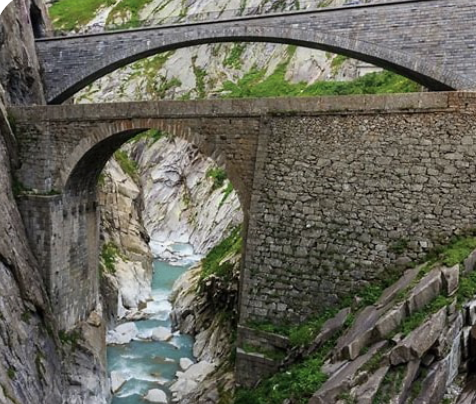
Take your pick, its 864 miles to Tefelsbrucke and a mere 54 miles to our very own Devils bridge in Wales.
BRIDGE FACTS (Wales only)
Here are the key details about this unique site are that: the original stone bridge, built around 1075-1200 and the Middle Bridge (1753) constructed when the original was deemed unstable. The old bridge was left intact and used to support scaffolding; and the Top Bridge (1901) was built, which is the current road bridge, made of iron.
LIVING HAPPILY EVER AFTER
This is not possible without knowing how the devil got his claws into all of this. Well hold on here is another story, and we promise the very last one. To the people living in the Middle Ages, these ancient stone bridges were marvels of engineering that seemed to defy logic.
Seemingly Impossible Construction that appeared far beyond the capability of local builders. When faced with such a perfect structure in such an impossible location, people often concluded that supernatural forces must have been involved.
The “Liminal” Space where bridges are also seen as transitional places, crossing from one side to another, which in folklore are often associated with magic and the supernatural. This made them the perfect setting for a story about making a deal with the devil.
This exact story is told about the bridge in Wales, the Ponte della Maddalena in Italy, the Pont Valentré in France, and the Teufelsbrücke in Switzerland , among others.
The stories are so consistently similar that folklorists have classified them as a specific tale type: the Aarne-Thompson-Uther type 1191. What the devil is this 1191 stuff well its world-renowned index used to classify folktales. But the core narrative almost always follows the same pattern:
1. The Impossible Task: A community needs to build a bridge over a treacherous ravine, but the task is too difficult, and they are facing a seemingly impossible deadline.
2. The Devil’s Bargain: The Devil appears and offers to build the bridge. His price is the soul of the first living creature to cross it .
3. The Clever Trick: The bridge is built (often overnight). The clever local, however, outwits the devil. Instead of a human, they throw a piece of bread or coax an animal—often a dog, but sometimes a pig or a rooster—to cross the bridge first.
4. The Devil’s Defeat: Enraged at being cheated of his prize, the devil is “discomfited” . He may plunge into the river below, throw a massive rock in anger, or storm off, leaving the community with its bridge and its soul intact.
So why is the story the same? This is the most intriguing part. It’s highly unlikely that every village copied the story from its neighbour. Instead, scholars believe these legends arose independently for the same underlying reasons.
Universal Human Experience Facing a daunting construction project and the desire to protect one’s community from evil are universal themes. The “deal with the devil” is a powerful, cross-cultural metaphor for pride and cutting corners, while the trickster figure represents cleverness overcoming a powerful foe.
Ancient Sacrificial Echoes Some scholars suggest the legend is a distant cultural memory of very old, pre-Christian traditions where a sacrifice (sometimes human or animal) was made to ensure a new structure would stand. The “first to cross” element may be a echo of these foundation sacrifices.
Explaining the Extraordinary most of these bridges are indeed remarkable architectural achievements for their time. The legend provides a simple, powerful explanation for their existence: they are so well-built, they could only be the work of a supernatural being.
In short, the Devil’s Bridges of Europe are connected not by a single event or person, but by a shared cultural heritage of storytelling. They are physical monuments to the medieval imagination, where awe-inspiring human achievement was seamlessly woven with folklore to explain the wonders of the world.
So, the legend and people crossing the bridges can live happily eve after.
