
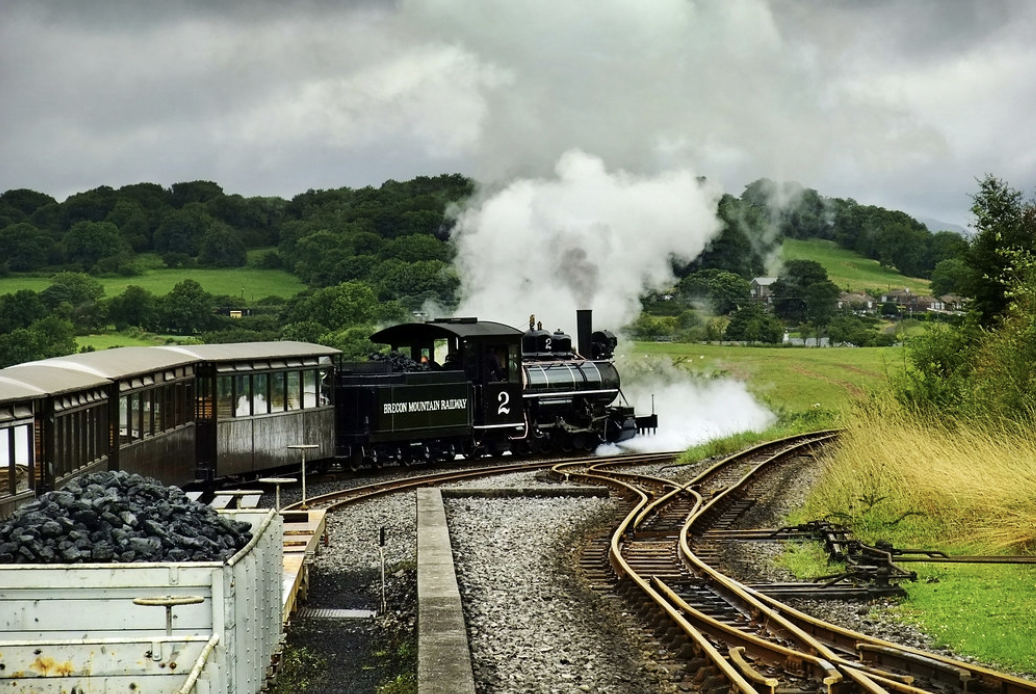
Catch the train, just 33 miles from The Living Energy Holidays. You will need to drive as there are no trains from Velindre (or taxis and buses come to that)!!. Take the slightly longer route through Crickhowell for good views of the other side of the Black Mountains and the south side of Brecon Beacons.
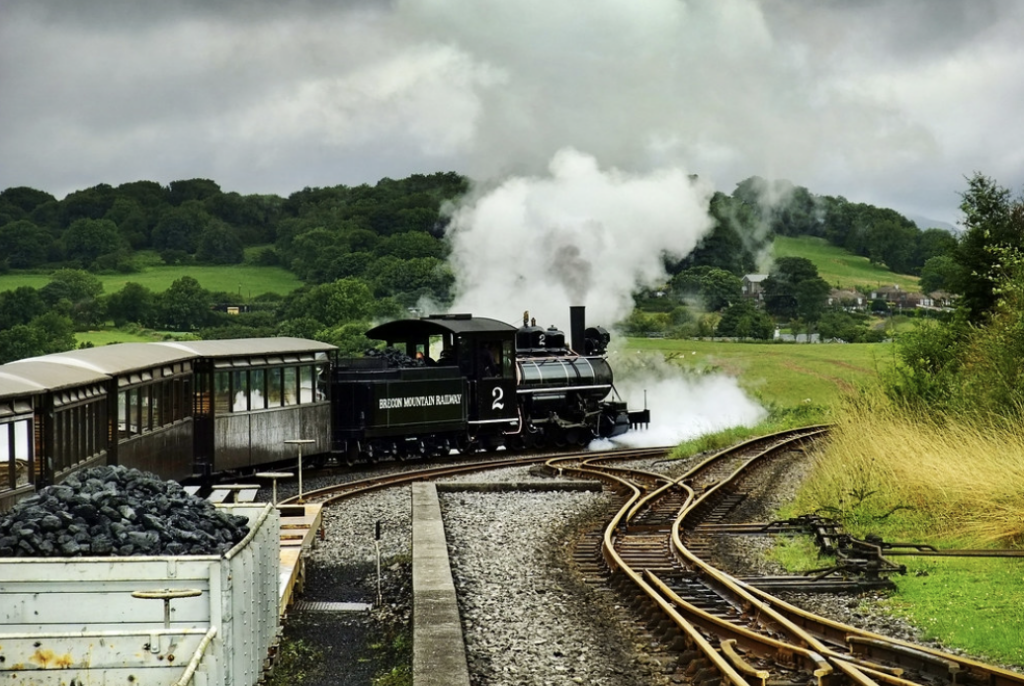
All Aboard the Time Machine!
Climb into the gorgeous vintage carriages, pulled by a proper, albeit a genuine narrow gauge, steam locomotive that puffs and chuffs along. As you settle in, you’ll feel the gentle rock and hear the iconic puffing, click clack, and thrusting steam through its whistle. This isn’t just a train ride, it’s a living history lesson that captivates kids (and kids-at-heart) from the very first whistle!
The Journey: Views, Viaducts & Maybe a Sheep or Two!
The train winds its way from Pant station up into the heart of the breathtaking Pontsticill Reservoir and the Brecon Beacons National Park. The scenery is simply stunning. You’ll glide past glittering water, over a dramatic viaduct, and through pine-scented forests, all from the comfort of your seat. Keep your eyes peeled for wild ponies, soaring birds of prey, and very photogenic sheep grazing on the hillsides!
Destination: Adventure at Pontsticill
The journey culminates at Pontsticill station, where the engine is turned around on a magnificent turntable, a real highlight for budding engineers! Here, you can:
- Explore the Visitor Centre and see other majestic engines.
- Let little ones loose in the play area.
- Enjoy a well-earned ice cream or a cuppa with a slice of cake at the lakeside café.
- Stretch your legs with a short, picturesque lakeside walk.
The Return Trip: Happy & Relaxed
The beauty of this day out is its lovely, manageable pace. The round trip takes about 1 hour 40 minutes, leaving everyone exhilarated but not exhausted. You’ll roll back into Pant station with a mass of photos, cheeks aching from smiling, and without a single “Are we there yet?”.
Remember!!
- Booking: Check the running timetable online before you go, especially outside peak summer months.
- The Gift Shop: It’s a treasure trove of train-themed souvenirs, your final challenge of the day!
- Combine Your Adventure: The railway is a stone’s throw from the beautiful Garwnant Forest Visitor Centre or the Brecon Beacons Mountain Centre, making it easy to extend your day in the great outdoors.
So, swap screen time for steam time and create some unforgettable family memories. It’s a day out that runs like clockwork!
The Brecon Railway is narrow gauge at 603mm. But not all narrow-gauge railways are a standard gauge, e.g. Ffestiniog is 597mm, Snowdon 800mm, Talyllyn 686mm, and Vale of Rheidol Railway 603mm. Today, the surviving narrow-gauge railways in England and Wales are almost exclusively heritage and tourist lines celebrating the technology that thrived in specific landscapes but ultimately could not compete with the universal advantages of the standard gauge network. Narrow gauge was not as useful for high-speed trains etc but remained to an extent because it was lower cost (rails and rolling stock) and prevalent in:
- Mountainous regions: e.g., the railways of Switzerland, Wales (Snowdon Mountain Railway), and the Rockies.
- Industrial settings: Mines, quarries, plantations, and factories where space was limited and tracks needed to weave around obstacles.
- Colonial and developing economies: Where capital was scarce and traffic volumes were initially expected to be low.
To wrap up this technical tangent, it’s amusing to remember that Isambard Kingdom Brunel once dreamed up his famously broad (and decidedly lonely) 7 ft ¼ in gauge for the Great Western Railway. Standing out like a sore thumb amongst the narrow and standard gauges. Unsurprisingly, it didn’t catch on. Perhaps Brunel had simply misplaced his tape measure that morning or fancied giving the other engineers something to gossip about! But of course snuggled in the middle is the gauge as we know it today at 4′ 8.5″. It stemmed from George Stephenson who used it in the Killingworth Colliery and Stockton and Darlington Railway at 4′ 8″. An extra half inch was added for the Liverpool Manchester Railway (it gave train wheels more space for going around curves without wheel screech). This became one of England’s greatest exports as it is the gauge used by 55% of railways throughout the World. And finally, I promise, it also replaced the US Unionist 5′ garage.
Enjoy your journey
